Living World Reactions — Designing Organic Consequence
A deep dive into how Aetheris builds a reactive world from the bottom up — where every signal produces a local, culturally specific response, and no two regions punish the same crime the same way.
Category
Design
Reading Time
14 Min
Date
Feb 12, 2026
The Core Model: Organic Reaction Mesh
In most RPGs, the world reacts to the player through scripted triggers. Kill a guard, and the entire city goes hostile. Steal an apple, and a bounty appears. These systems are functional, but they're brittle — and they all feel the same regardless of where you are or who controls the territory.
Aetheris replaces this with what we call the Organic Reaction Mesh: a bottom-up system where events produce signals, nearby actors perceive and appraise those signals through cultural and doctrinal lenses, and the resulting actions create small, legible, locally authentic changes.
The world reacts not because a script tells it to, but because the actors within it have reasons to care.
How Signals Work
Every player action that affects the world generates a signal. These signals are simple and concrete: Noise, Violence, Trespass, Ritual Input, Fire, Theft, Bribe Offered, Contraband Seen, Crowd Panic, and others.
Each signal carries four pieces of data: who caused it, where it happened, when it happened, and how strong it was. That's it. No moral judgment. No alignment tag. Just a fact about the world.
What matters is who hears it.
Perception and Appraisal — Culture Shapes Response
Only actors within range and with matching interest "wake up" when a signal fires. A guard notices violence. A clerk notices contraband. A druid notices a broken oath. A smuggler notices an opportunity.
Once an actor perceives a signal, they run a short appraisal — not a complex AI decision tree, but a scored list based on duty, risk, reward, doctrine, fear, bond, heat, and myth tag. The top-scoring intent wins.
The available intents are: Confront, Summon, Investigate, Ignore, Exploit, Aid, Report, Extort, Evacuate, Calm, Bless, Sanction, Exile.
But here's the key: policy gates prune the menu before utility picks. If an action isn't legal or doctrinally allowed in this territory, it isn't even considered. A Keltus Druid will never respond to an accidental killing with lethal force — it's not in their doctrine. A Tainted Hand Enforcer will never refuse a bribe on principle — intimidation is their baseline.
This means the same signal produces fundamentally different responses depending on where it happens.
Culture Profiles — Why Every Territory Feels Different
Each territory in Aetheris has a cultural profile defined by five sliders: Lawfulness, Corruption, Piety, Tension, and Crime Pressure. These sliders bias which actors appear, which incidents are possible, and how frequently things escalate.
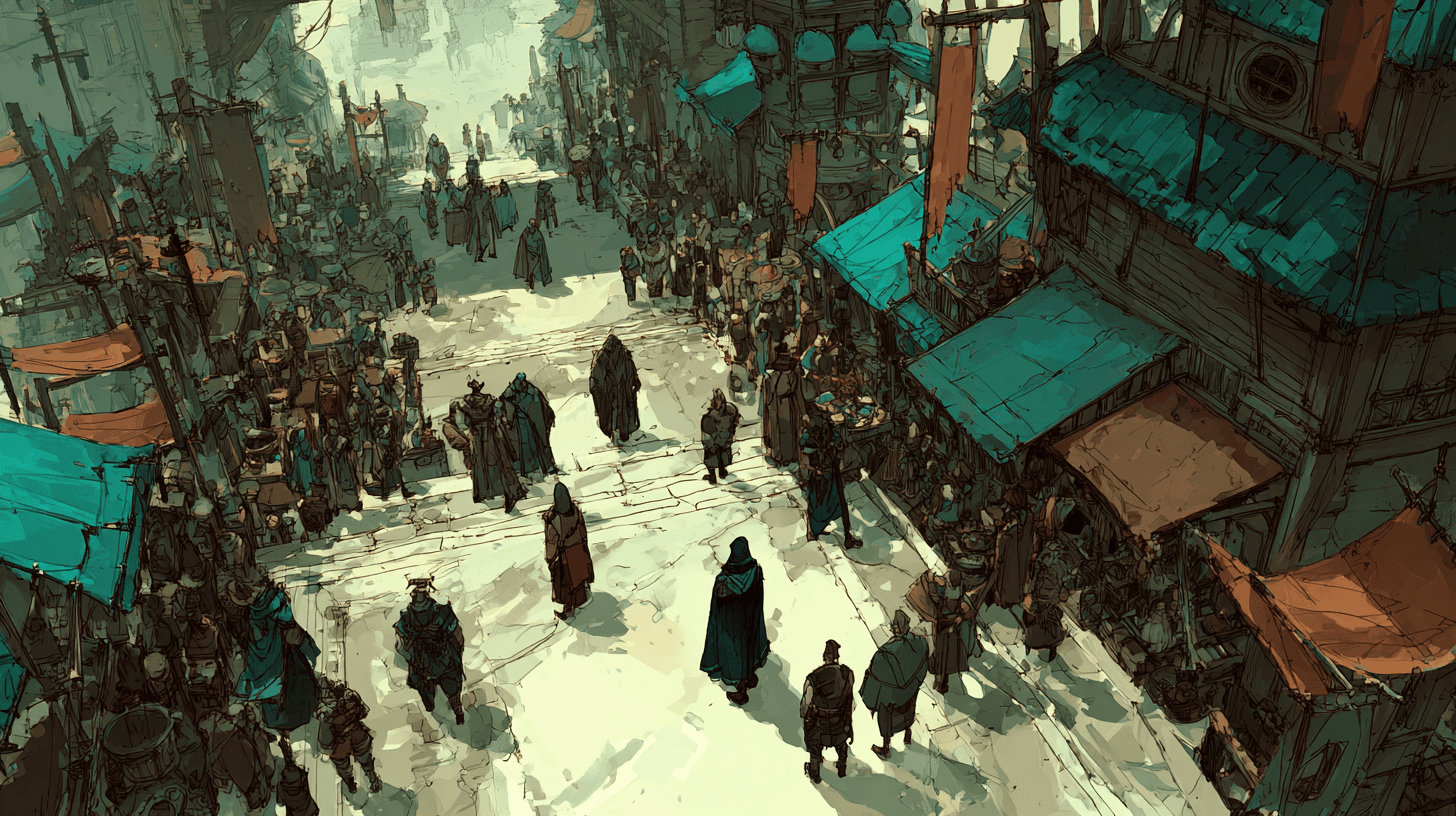
Kyadamri runs low-to-mid lawfulness with high corruption and high crime pressure. It's a frontier bazaar — intimidation is acceptable, lethal force is reserved for riots or Order intervention, and the marketplace has its own ritualized conflict resolution. Haggler Duels are a legitimate form of commerce where a call-and-response bargaining rite determines who gets a discount. Water Blessings at the noon cistern provide temporary environmental buffs to those who participate. These aren't flavor — they're systemic rituals that change how the player interacts with the economy.
Keltus runs high lawfulness with very low crime pressure. But "crime" in Keltus doesn't mean theft or assault in the traditional sense — it means taboo breach. Breaking an oath, disturbing a sacred harvest, violating silence hours. Consequences are admonition, oathmark, penance, or exile. Never lethal force against civilians. The entire culture resolves conflict through ritual and social pressure, not police violence.
First Hand territory uses audits before force. Non-lethal ladders. Paperwork. Bureaucratic intimidation. A clerk might "lose" your permit. A guard might demand documentation you don't have.
Tainted Hand territory allows intimidation as a baseline tool. Bribes are mid-level acceptable. Lethal force requires explicit authorization.
Neutral zones are enforced by the Vellari — peacekeepers whose authority all factions respect because the sanctions are immediate and costly. Inside neutral territory, violence is met with instant binding, fines, exile, and faction-wide sanctions. A violation at one neutral hub triggers consequences at all neutral hubs in the region for 24 hours.
The Blood-Quiet Rite: A Case Study in Cultural Consequence
To show how this works in practice, consider what happens when the player accidentally kills a civilian in Keltus territory.
The moment it happens, the crowd goes silent. Wardens surround Kaelen non-lethally. The nearest druid performs the Blood-Quiet Rite — applying a Blood Oathmark to Kaelen's forearm. Her weapon, Alesdair, manifests a Muted Edge: -5% damage for 24 in-game hours while in Keltus.
For the next 24 hours: Keltus vendors refuse service. Priests won't offer blessings. Companions react — Maera disapproves, Tarin registers slight disapproval. The player's standing in Keltus professional networks is temporarily capped.
But the system also provides atonement paths. The player can choose to sit vigil at a shrine from dusk to dawn, deliver herbs to the bereaved household, or escort a druid through a quiet route without violence. Any of these clears the oathmark early.
If the player reoffends within 24 hours, they're exiled from Keltus steadings for 48 hours — not through a loading screen, but through ferries and wayhouses denying entry.
This entire sequence is culturally specific. The same accidental killing in Kyadamri territory would produce a completely different chain of events — probably involving a fine, a brief market disruption, and someone trying to exploit the situation for profit.
Actor Archetypes — Verbs, Not Scripts
Every NPC archetype in the reaction system is defined by eight weighted verbs that scale based on the territory profile, site tags, and time of day.
A Keltus Druid operates with: Tend Shrine, Bless, Admonish, Invoke Silence, Mark Oathbreaker, Gather Herbs, Call Wardens, Refuse Trade.
A Kyadamri Stallmaster operates with: Haggle, Short-Weigh, Pay Fee, Call Lookout, Tip Smuggler, Raise Prices, Cry Theft, Close Stall.
A First Hand Clerk operates with: Paperwork, Audit, Shake-down, Take Bribe, Call Guards, Deny Permit, Stamp, Lose Form.
A Tainted Enforcer operates with: Patrol, Intimidate, Collect Fee, Rough-Up, Accept Bribe, Arrest, Radio, Drink.
These aren't AI behavior trees — they're design constraints that ensure every actor feels authentic to their culture and role. When multiple actors respond to the same signal, brokers coordinate: the Patrol Leader caps active chases, the Clerk Hub batches reports into a single inspection window, and the Smuggler Ring collapses multiple "exploit" responses into one market spike.
Safety Fences — Bounded Emergence
The system is designed for emergence, but emergence with guardrails.
Hard rules are always true: no lethal force on civilians without explicit hostile authorization, no violence inside sanctuaries, no collateral from explosives near crowds. These aren't suggestions — they're mechanical locks.
Doctrine masks remove actions before the utility function even runs. A First Guard has high bribe rejection and arrest bias. A Keltus Warden has no bribes and no lethal force — ever. A Vellari operative binds, ejects, and bans, but never brawls.
The Use-of-Force Ladder ensures guards escalate predictably: Command → Block → Shove → Arrest → Lethal (locked behind authorization). Different factions climb this ladder at different speeds, but the lethal lock remains consistent.
This creates a system where the player can push boundaries and explore consequences without ever hitting a moment that feels arbitrary or unfair.
Reaction Channels — What Actually Changes
When the system produces a response, it manifests through six concrete channels: patrol routes and density, inspections and prices, rumors and myths, professional network standing, dream-ink hint weighting, and physical access (doors, gates, curfews).
The rule is: fire no more than two channels heavily per incident. This keeps changes legible. When the player causes a major disruption, they see one or two clear consequences — not a cascade of overwhelming feedback.
Player-facing feedback is designed to be readable in one second. Toasts appear for major state changes: "Surprise inspections scheduled (24h)" or "Oathmark applied — shops refuse service (24h)." Ambient voice lines from guards and civilians match the culture and event. Visual changes — banner shifts, patrol count changes, stall shutters closing — reinforce the state without requiring UI.
The Authoring Workflow — Designing Without Drowning
One of the biggest challenges with a reactive world is keeping it authorable. If every location requires custom scripting, the system collapses under its own weight.
The authoring workflow for Aetheris is deliberately minimal. To create a reactive location, a designer picks a territory profile, sets five sliders, tags the site with 2-4 descriptors, selects 2-5 actor archetypes, chooses 2-3 incidents from the shared library (reskinned for culture), decides which two reaction channels those incidents can affect, writes 1-2 toasts and voice lines, and adds one dream-ink bias line.
That's it. The system handles the rest. Templates for specific locations build on top of this foundation, but the foundation itself is lightweight enough to scale across an entire world.
Design Philosophy
The Living World Reactions system exists to serve a single principle: the world should feel like it has its own reasons for doing what it does.
Players should never feel like they triggered a script. They should feel like they did something in a place with its own rules, and the people who live there responded the way people who live there would respond.
That's the difference between a reactive world and a scripted one. Scripts respond to the player. A reactive world responds to itself — and the player happens to be part of it.
Related Articles